
When the King entered the House of Representatives, members of Congress had one thing on their mind: capturing the moment for social media. During a standing ovation, a congressman literally turned around to take a selfie with the King. Celebrity status gives the King an advantage in this usually boisterous and indecorous Congress – as did his humour. He began by recounting Oscar Wilde’s quip that “We have really everything in common with America nowadays, except, of course, language.” The laughter was hearty. He said that if Charles Dickens had written a story about the American Revolution, he might have entitled it, “The Tale of Two Georges”. One Congressman gave the King a thumbs up when he said he was anchored by Christianity. Everything was going swimmingly.
But beneath the witticisms, lay a rebuke. The ovation from Republicans became increasingly reluctant. When the King said that the protection of nature should be a priority for America over the next 250 years, the Democrats rose quickly; the Republicans slowly got to their feet. I looked at Howard Lutnick, the Commerce Secretary, who had his arms crossed and was not clapping. The King is more popular than the country he leads.
This was a speech that officials wanted to use to lay out the government’s position. But instead of sending their hapless Prime Minister, they would work with the grain of Americans’ love for our royals. One official compared it to the King’s Speech in Parliament, where the monarch becomes the government’s mouthpiece. The King was heavily involved in the drafting – but so were officials with an eye on the politics.
He made veiled criticisms on Ukraine, Nato, executive overreach and the environment. The King reminded Congress that the only time Nato’s Article 5 had been triggered was after the September 11 attacks. “Today, Mr. Speaker, that same, unyielding resolve is needed for the defence of Ukraine and her most courageous people.” This was politics couched in regal tones.

Looking back at the last and first time that a British monarch spoke to a joint session of Congress shows how much has changed. It was 1991. The First Gulf War had just been won. Queen Elizabeth walked into the chamber, as her son would do 35 years later. After a two-minute standing ovation, Elizabeth sardonically raised her eyebrows before everyone took their seat. Despite her reputation for staying above politics, watching it back now makes one think that it was just that what she said was so widely accepted that she was seen as apolitical. What was once taken for granted is now fiercely contested.
“Your Congress and our parliament are the twin pillars of our civilisations,” the Queen said. Note the plural: not our joint Anglo-Saxon civilisation, but separate ones. “Force in the end is sterile,” she said. If this was said today, it would have been seen as an attack on Trump. Back then, the Queen was talking about Saddam Hussein. Consider that when Charles III said today that America’s checks and balances on executive power came from Magna Carta, the Democrats roared with approval. The man they had in mind was obvious.
Referring to the First Gulf War, Queen Elizabeth II said “our views were identical and so were our responses”. Such things could not be said about the Third Gulf War. She praised the fall of the Iron Curtain and called for the “new Europe” in a post-Soviet world to be “open and liberal”. The administration today, meanwhile, sees funding the radical right as the solution to Europe’s malaise. And then she went on to praise the “rich ethnic and cultural diversity” of both countries, citing it as a strength. Again, these things are no longer presumed to be good.
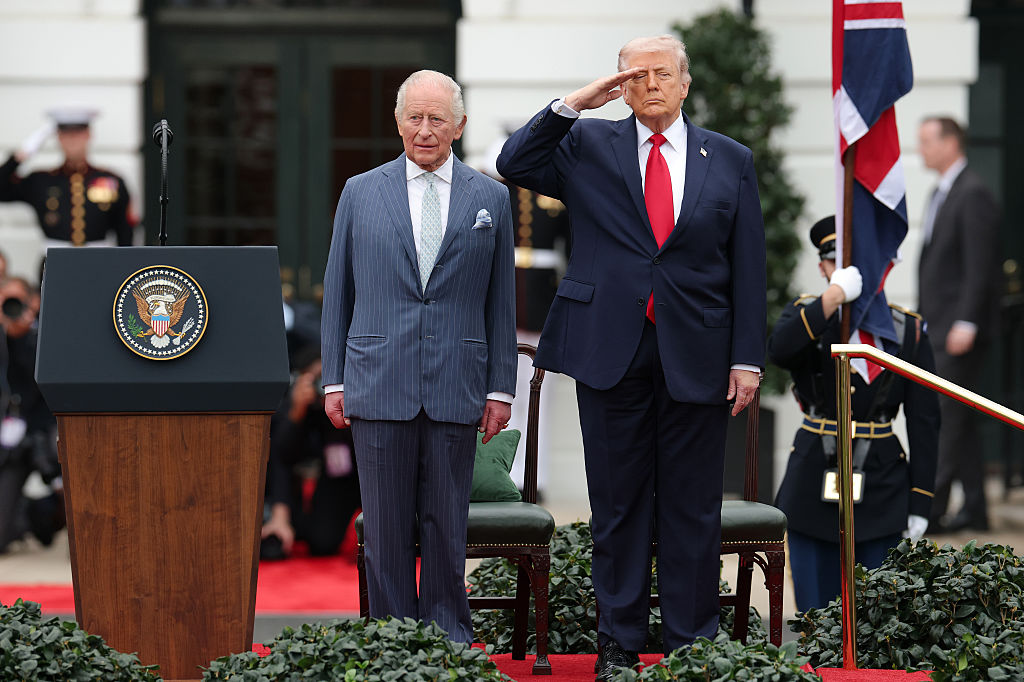
That was very clear earlier in the day. On the White House South Lawn, President Trump gave one of the most remarkable speeches of his career with the King sitting to his left. He argued that America is not constituted by republican ideals, but explicitly owes its character to its Anglo-Saxon heritage. “For nearly two centuries before the revolution, this land was settled and forged by men, women who bore in their souls the blood and noble spirit of the British,” Trump said. “Their veins ran with Anglo-Saxon courage.”
I can’t think of Trump giving a speech as coherently argued – and therefore a step change in Maga ideology – since his first inaugural address. One of the key authors of that 2016 speech, Steve Bannon, texted me after Trump’s speech today to say: “Old School ‘Blood and Soil’ – in front of George V’s heir kicking off America’s 250th Independence Celebration – Epic”.
This argument is gaining traction on the Maga right: that America is not defined by the universal ideals proclaimed in the Declaration of Independence, but the Anglo-Saxon culture and creed from which those ideals came. The lineage is carried into the present by ancestry, ie blood. One Maga figure told me they thought the speech was written by Stephen Miller and his lieutenant, Vince Halley.
JD Vance has talked in similar terms, rejecting the notion that America is an idea, and claiming that those with American ancestors are more American than recent arrivals. As I’ve written before, the agonised affection that Maga feels for Britain is explained by the fact that Maga is an ethnic project. They look askance at the demographic changes in Britain and blame leaders such as Keir Starmer. (As an aside, last Thursday, I saw the Irish ambassador joke to a room of Americans that they all wanted to have Irish DNA – something I can’t imagine a British politician ever saying to a diverse crowd.)
These three separate speeches show how the ideas underpinning the relationship across the Atlantic are changing. The King’s trip has gone off without much of a hiccup. It will be lauded in the White House, and you can imagine that No 10 will be happy. The King has charmed the Americans with aplomb. Someone said to me at the garden party yesterday that here were 600 powerful Americans who will all leave with warm thoughts about Britain. That is true. You could say the same about the members of Congress gathered today. But something is changing. Those old assumptions are no longer to be assumed.
[Further reading: The worst people in the world love King Charles]
Content from our partners



Related


Join the debate
Subscribe here to comment